


Token Metrics Premium
100,000+ Read the Brief. The Smartest Go Deeper.
Signals before they trend. Reports before they matter.
Playbooks before the market moves.
Weekly alpha signals · Premium reports · Monthly playbook · Private Discord
See What’s Included →From $49/mo · Or hold 1M+ $TMAI for free access
Lead Change
BTC funding rates just hit their most negative since 2023. Price sits at $74K. Short-term holders are hunting exits. Historically, this is where bottoms form — not where they break.
Market Snapshot
BTC is grinding sideways near $74K with essentially flat 24-hour moves across the board. SOL is the one exception — up 2% and leading the majors.
Narratives Snapshot
Memes are the clear winner this week, up 17% in market cap while AI tokens shed 4%. That's a meaningful rotation — capital moving from last cycle's hottest narrative into pure sentiment plays.
What Prediction Markets Think
Prediction markets are collectively pricing out the optimistic scenarios: 2% on BTC at $500K, 8.5% on three Fed cuts, and near-certainty that MicroStrategy holds. The money isn't betting on acceleration — it's betting on more of the same sideways grind.
Data from Polymarket prediction markets • Prices reflect real-money bets
Sponsored

Polymarket — Bet on real-world events with real money on the world's prediction market.
Predict & Earn →5 Changes That Matter
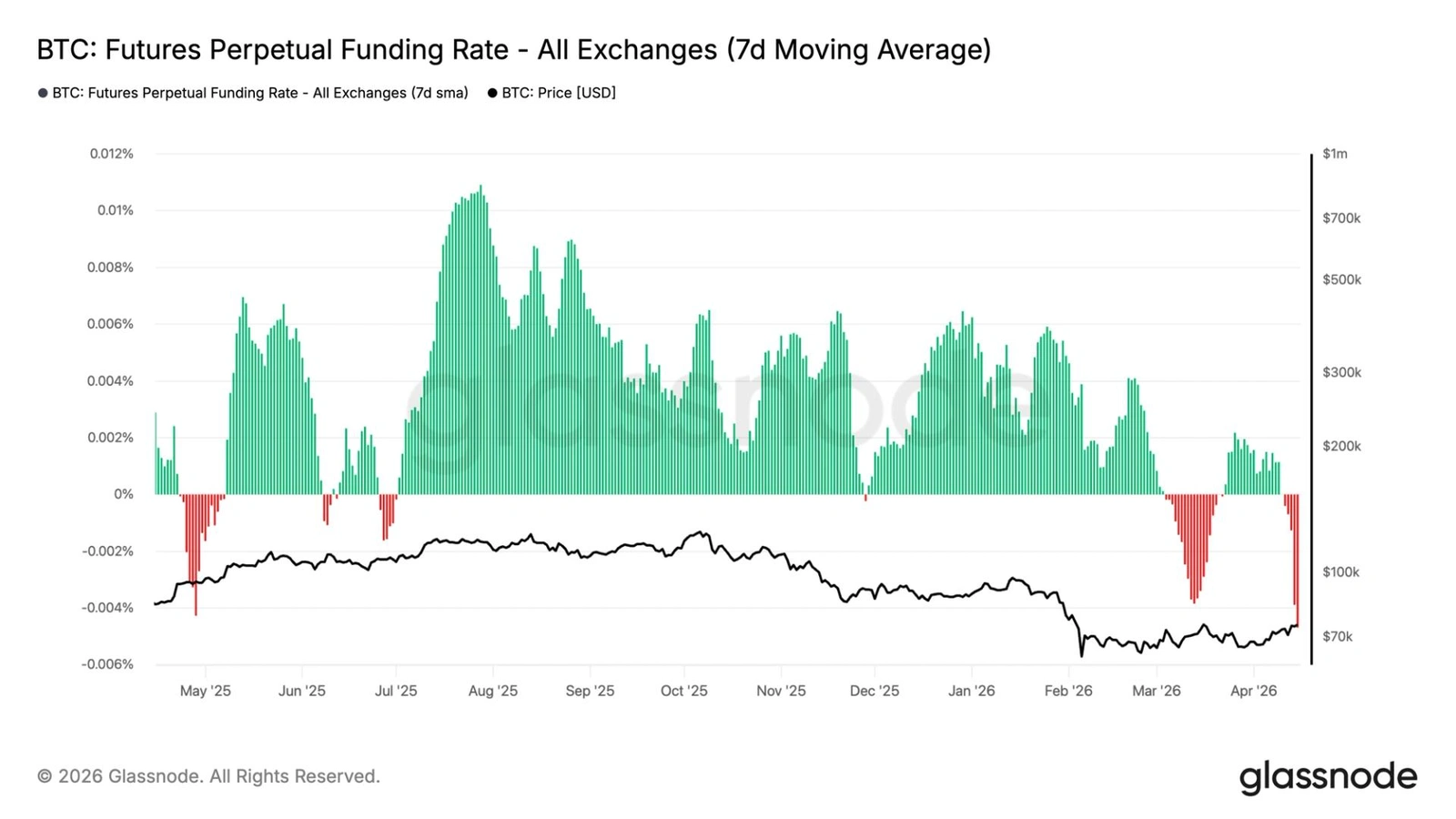
1 Bitcoin funding rates just hit their most negative reading since 2023 — and history says that's actually a bullish setup.
When funding rates go deeply negative, it means shorts are paying longs to hold their positions. That's not a sign of conviction — it's a sign of crowding. The last two times funding got this negative, BTC was within days of a local bottom. The logic: when everyone who wants to be short already is, there's nobody left to sell. The squeeze writes itself. That said, 'history suggests' is doing a lot of heavy lifting here. Macro headwinds are real, and a crowded short can stay crowded longer than your margin account survives.
If funding rates stay negative for 3 or more consecutive days while BTC holds above $73K, shorts are trapped and a squeeze becomes the base case. If funding flips positive while price drops below $72K, the crowded short unwound into a real breakdown — that's a different story entirely.
2 Drift Protocol just raised $148 million from Tether and partners — days after a massive exploit — and is replacing USDC with USDT as its primary stablecoin.
Let's be direct about what happened here. Drift got hit by a major exploit. Instead of dying quietly, it raised $148 million and switched its entire stablecoin infrastructure from Circle to Tether. That's not a recovery — that's a pivot. Tether becoming the primary liquidity provider for a major Solana perps exchange is a meaningful shift in the DeFi power structure. Circle loses a flagship integration. Tether deepens its on-chain presence. And Drift's users now have to decide whether the new backing makes them more or less comfortable than before the hack. The answer probably depends on your feelings about Tether's attestations — and we all know how that conversation goes.
Watch Drift's open interest and user counts over the next 7 days. If they recover to pre-exploit levels, the $148 million bet paid off and Tether's DeFi strategy is working. If TVL stays depressed despite the raise, the exploit did reputational damage that capital alone can't fix.
3 Bitcoin developers are proposing BIP-361 — a plan to freeze wallets that are vulnerable to quantum computing attacks.
Here's the uncomfortable math: a meaningful chunk of early Bitcoin — including coins that almost certainly belong to Satoshi — sits in wallets using cryptography that a sufficiently powerful quantum computer could crack. BIP-361 proposes freezing those wallets before that becomes a problem. The proposal from Adam Back and the developer coalition is framed as optional upgrades, but 'optional' gets complicated when the alternative is watching someone drain Satoshi's coins on a Tuesday afternoon. The counter-argument, from Bit MEX's research team, is that a quantum freeze could itself be weaponized — locking out legitimate owners who simply haven't upgraded. There's no clean answer here. But the fact that serious developers are debating it publicly means quantum risk has graduated from thought experiment to active protocol concern.
If BIP-361 gets formal BIP number assignment and enters the review process within the next 7 days, the quantum conversation is moving from Twitter to the actual development track. If it stalls at the proposal stage, treat it as a signal that consensus on the freeze mechanism doesn't exist yet — and the debate continues.

4 The UK's FCA opened a fresh consultation on crypto regulation — and South Korea announced a blockchain deposit token pilot for government spending in Q4.
Two separate regulatory moves in one day, and they're telling different stories. The UK is still in the 'asking questions' phase — the FCA wants feedback on crypto rules, which means actual rules are probably 12 to 18 months away. South Korea is moving faster: a live government pilot of tokenized deposits for public spending. That's not a whitepaper. That's a treasury department putting real money on-chain and seeing what breaks. The contrast matters. Europe talks about crypto regulation like it's a philosophy seminar. Asia runs pilots. The countries that build the infrastructure first tend to write the rules that everyone else adopts later.
Watch whether the FCA consultation attracts responses from major UK-based institutions within the 30-day window. Heavy institutional participation signals the industry expects rules to actually land. Meanwhile, if South Korea's Q4 tokenized deposit pilot launches on schedule, it becomes a live case study that every other government finance ministry will be watching.
5 Exchange inflows for BTC spiked as price approaches the $76K resistance level — a classic signal that short-term holders are preparing to sell.
Exchange inflows spike when holders move coins onto exchanges to sell. Near resistance, this is the market's version of people queuing at the exit. Short-term holders — those who bought in the last few months — are sitting on thin margins and a lot of them are looking for any green to get out flat or slightly up. That's the supply wall at $76K. It's not mysterious. It's just math: a lot of people bought between $75K and $82K during the last run, and they've been underwater or barely breaking even since. Price needs to absorb that supply before it can go higher. The question isn't whether the wall exists — it does. The question is whether demand is strong enough to eat through it.
If exchange inflows normalize and BTC closes above $76K on daily volume within the next 48 hours, the supply wall got absorbed and the path to higher prices clears. If inflows stay elevated and price gets rejected at $76K twice, that resistance is real and a retest of the low $70Ks becomes the more likely near-term scenario.
5 Quick Hits
- France doubles security at crypto conference after wave of physical attacks on executives — Physical attacks targeting crypto holders and executives in France have gotten serious enough that the government is deploying extra security at industry events — a reminder that on-chain anonymity doesn't protect you when someone knows your home address.
- WLFI proposes vesting schedule to appease disgruntled token holders — Trump-backed World Liberty Financial is trying to calm token holder frustration with a vesting schedule proposal — governance drama at a project with direct presidential ties is the kind of thing that tends to attract regulatory attention.
- Ohio casino regulator fines Kalshi $5 million — Kalshi, the prediction market platform that won its CFTC legal battle, is now facing state-level gambling enforcement — a reminder that winning federally doesn't mean the states are done fighting.
- Keep an eye on XRP, Plasma, DOGE as bitcoin drifts — Developing story.
- Google's Latest AI Update Makes Industrial Robots Way Smarter—Here's How — Developing story.
Risk Map
Catalysts (Next 7 Days)
Token Metrics Podcast
Read It Later. Hear It Now.
The Token Metrics Podcast turns the morning brief into a clean audio rundown of what changed, why it matters, and what to watch next.
What changed · Why it matters · What to watch next
Daily audio briefing · Spotify · Apple Podcasts · More
Sources
- Bitcoin funding rates just hit their most negative... coindesk.com
- Exchange inflows for BTC spiked as price approaches... coindesk.com
- Bitcoin funding rates just hit their most negative... insights.glassnode.com
- Drift Protocol just raised $148 million from Tether... coindesk.com
- Drift Protocol just raised $148 million from Tether... chainalysis.com
- Bitcoin developers are proposing BIP-361 — a plan... bankless.com
- Bitcoin developers are proposing BIP-361 — a plan... decrypt.co
- Bitcoin developers are proposing BIP-361 — a plan... decrypt.co
- Bitcoin developers are proposing BIP-361 — a plan... blog.bitmex.com
- The UK's FCA opened a fresh consultation on... decrypt.co
- The UK's FCA opened a fresh consultation on... coindesk.com
- Exchange inflows for BTC spiked as price approaches... decrypt.co
- Exchange inflows for BTC spiked as price approaches... insights.glassnode.com
- api.coingecko.com api.coingecko.com
- api.coingecko.com api.coingecko.com
- api.llama.fi api.llama.fi
- Will Bitcoin reach $500,000 by December 31, 2026? polymarket.com
- Will 3 Fed rate cuts happen in 2026? polymarket.com
- MicroStrategy sells any Bitcoin by June 30, 2026? polymarket.com
Disclosures
Not investment advice. For education only. Crypto is high risk. We may earn affiliate revenue from some links.
