


Token Metrics Premium
Go Beyond the Brief
The Daily Pulse gives you the view.
Premium gives you the signals, the reports, and the playbooks.
Token & prediction market signals · Alpha Weekly Report · Monthly Playbook · Private Discord
Explore Premium →From $49/mo · Or hold 1M+ $TMAI for free access
Lead Change
Bitcoin clears $78K for the first time in weeks. $418 million in liquidations in 24 hours. ETH up 4%, SOL up 4%. The short squeeze the bears didn't see coming.
Market Snapshot
Bitcoin clears $78K on a short squeeze, dragging alts higher. ETH and SOL both up meaningfully.
Narratives Snapshot
Memes are running the show this week — 42% up in 7 days with a $52 billion market cap. That's not a narrative, that's a momentum trade with a pulse.
What Prediction Markets Think
Prediction markets are telling a clear story: BTC at $110K this month is essentially off the table at 0.15%, and Fed rate cuts are being priced out of 2026. The rally to $78K is being read as a mechanical event, not a regime change — and the market is betting Strategy's Bitcoin never hits the sell button.
Data from Polymarket prediction markets • Prices reflect real-money bets
5 Changes That Matter
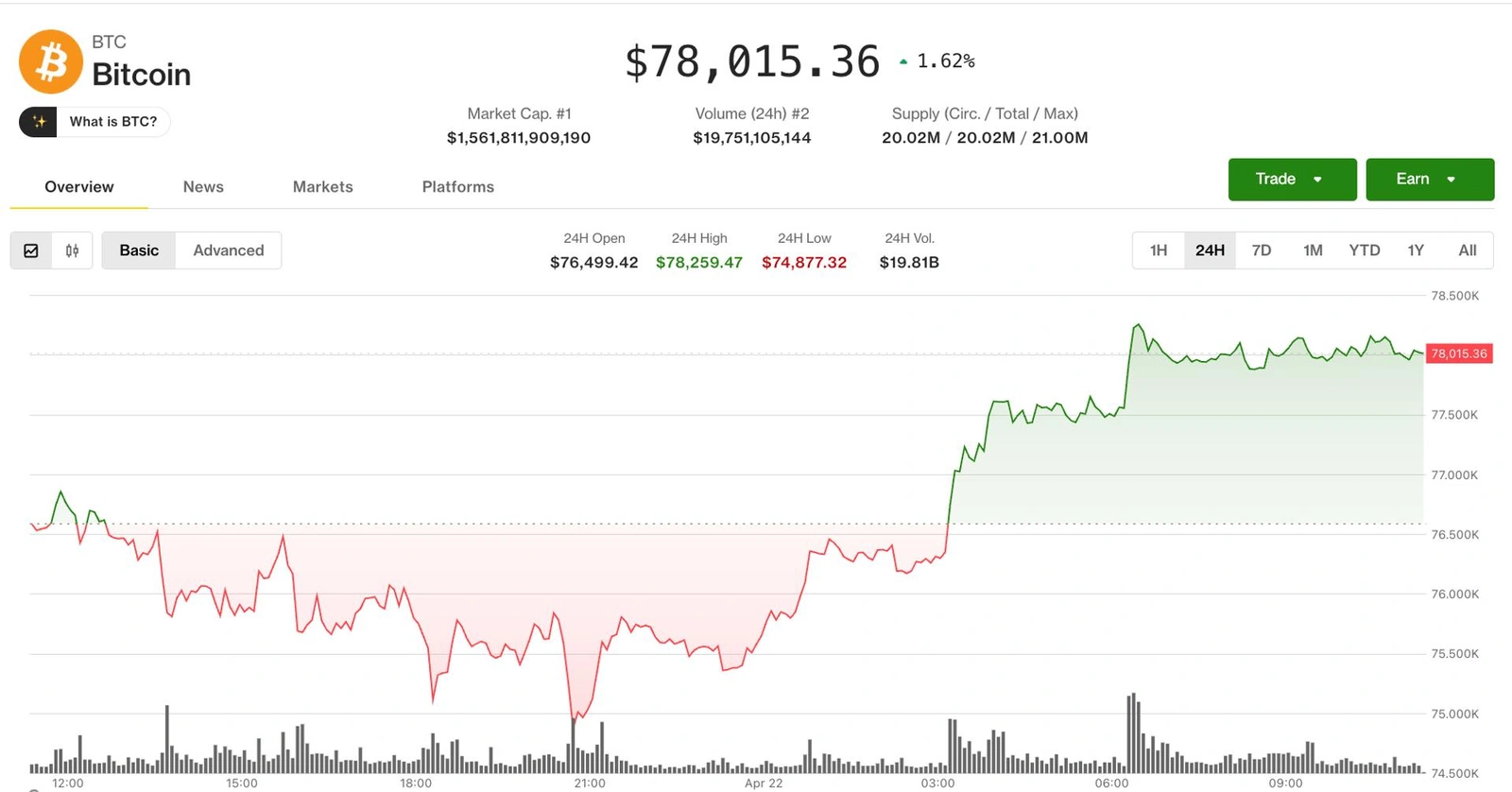
1 $418 million in crypto liquidations in 24 hours as Bitcoin tests $78K resistance and short sellers get caught offside.
This is what a short squeeze looks like in real time. Traders who leaned bearish into last week's range got steamrolled. The move from the low $74K range to $78K wasn't driven by fresh news — it was driven by forced buying. Shorts covering creates the very rally they were betting against. The Bollinger Bands on BTC have been compressing for weeks, which historically precedes a sharp directional move. The question now: is this the start of something, or just a mechanical flush before the range reasserts itself? Bitcoin's bull score just hit a six-month high according to on-chain data. That's not nothing.
If BTC closes above $78K for 3 consecutive days while open interest rebuilds, the squeeze has legs and fresh buyers are entering. If price fades back below $76K within 48 hours, this was a mechanical flush and the range is still in control.

2 Lazarus Group has a new attack vector: a mac OS-targeting exploit called Mach-O Man, and they're using LayerZero and other bridges to launder the proceeds.
North Korea's crypto operation is getting more sophisticated, not less. The Mach-O Man attack targets mac OS binaries — which means developers, not just retail users, are in the crosshairs. Cert IK flagged this as a significant escalation. Meanwhile, Protos reports that Lazarus is routing stolen funds through cross-chain bridges including LayerZero to obscure the trail. This is the double threat: they're getting better at stealing, and better at cleaning. The DeFi bridge ecosystem was built for speed and composability. It was not built to resist a nation-state actor with a multi-year laundering operation. Every bridge that processes volume without robust screening is a potential node in someone else's money trail.
If LayerZero or other named bridges implement on-chain screening or OFAC compliance tooling within the next 7 days, watch for a governance or community response — compliance friction could trigger outflows to less-screened alternatives. If no action is taken, expect the next regulatory letter to name bridges specifically.

3 Aave's TVL is sliding, with capital rotating to Spark and Lido — and USDC is becoming the default parking spot for DeFi cash sitting on the sidelines.
When the biggest lending protocol in DeFi loses TVL, it's worth asking why. The answer here isn't a hack or a governance failure — it's competition and yield dynamics. Spark (MakerDAO's lending arm) and Lido are pulling capital with better yield profiles. Meanwhile, USDC accumulating as a 'parking spot' is a tell: traders are in DeFi but not deploying. They're waiting. That's not bearish exactly, but it's not the kind of active capital that moves prices. It's dry powder sitting in a stablecoin wrapper. The Aave TVL story is also a proxy for the broader DeFi maturation trade — protocols that were first movers are now fighting for yield-sensitive capital that will move at the drop of a basis point.
If Aave's TVL stabilizes or reverses within 7 days as BTC rallies and risk appetite returns, capital was just rotating temporarily. If Spark and Lido continue gaining share through next Wednesday, the competitive shift is structural and AAVE token holders should pay attention.

4 New York's Attorney General sued Coinbase and Gemini, classifying prediction markets as illegal gambling operations. Meanwhile, a federal court sided with Coinbase on a separate prediction markets case.
Two courts. Two different answers. On the same day. That's the state of prediction market regulation in America right now. The NY AG's move is the aggressive read: if you let people bet on outcomes, you're running a gambling operation and you need a gambling license. The federal court's ruling cuts the other way, suggesting prediction markets may have a legitimate home under existing commodity law. Polymarket and Kalshi are already planning perpetual futures expansion — they're betting (appropriately) that federal jurisdiction wins. But if New York's theory spreads to other state AGs, the legal geography gets complicated fast. This is the prediction market industry's version of the early crypto exchange battles: survive the state-by-state assault long enough for federal clarity to arrive.
If the federal court ruling is appealed within 30 days, watch for prediction market platforms to accelerate their federal registration push as a defensive move. If the NY AG files injunctions against active platforms within 7 days, expect a rapid shift of US-facing volume to offshore or non-NY-incorporated entities.
5 Base launched its Azul testnet upgrade with multiproofs, a concrete step toward decentralizing the sequencer — and Arbitrum's security council froze $70 million in ETH tied to the Kelp DAO exploit.
Two L2 stories. One is about building trust, the other is about testing it. Base's Azul upgrade introduces multiproofs — multiple independent proof systems verifying the same state transition. That's the engineering answer to 'what if the prover is wrong or compromised.' It's not flashy, but it's the kind of infrastructure work that separates L2 s with a real decentralization roadmap from ones that are just fast centralized databases with a blockchain aesthetic. Meanwhile, Arbitrum's security council stepping in to freeze $70 million in ETH from the Kelp DAO exploit is the other side of the coin: L2 governance still has emergency override powers. That's a feature when it stops a hack. It's a question mark when you ask who controls those keys and under what conditions.
If Base's Azul multiproof system passes testnet without critical bugs and moves toward mainnet within 30 days, it sets a new benchmark for L2 decentralization credibility. If Arbitrum's frozen funds are released or challenged by governance vote within 7 days, watch for a broader debate about security council powers across the L2 ecosystem.
5 Quick Hits
- Kraken filed 56 million crypto tax forms for 2025 — a third were under $1 — The sheer volume of sub-$1 filings reveals how many micro-transactions now fall under IRS reporting requirements, signaling that crypto tax compliance infrastructure is scaling whether traders are ready or not.
- Justin Sun sues Trump-backed World Liberty Financial over frozen tokens — Sun alleges World Liberty Financial froze tokens he purchased, turning a high-profile Trump-affiliated DeFi project into a legal dispute that puts both parties' reputations on the line before any verdict.
- The signal bitcoin momentum traders have been waiting for is here — Bitcoin's push through $78K on April 22 triggered a momentum signal that on-chain analysts had flagged as a key threshold — BTC's bull score reached a six-month high, and the $418 million liquidation flush cleared the overleveraged shorts that had been capping upside for weeks.
- Top Law Firm Admits to AI 'Hallucinations' in Bankruptcy Filing Tied to Alleged Scam Network — A prominent law firm acknowledged that AI-generated content containing fabricated case citations made it into a bankruptcy court filing connected to an alleged crypto scam network, raising immediate questions about legal liability when AI errors enter official court records.
- Morning Minute: Bitcoin Passes $78k as Trump Extends Ceasefire Indefinitely — Bitcoin crossed $78K on April 22 as President Trump announced an indefinite extension of a ceasefire agreement, with risk assets broadly rallying on the geopolitical de-escalation news alongside the crypto short squeeze already in motion.
Risk Map
Catalysts (Next 7 Days)
Token Metrics Podcast
Your 10-Minute Crypto Morning Brief
Start with the same sourced Daily Pulse read in audio form when you want the signal without opening another tab.
Daily market context · Fast to finish · Available across major podcast apps
Daily audio briefing · Spotify · Apple Podcasts · More
Sources
- $418 million in crypto liquidations in 24 hours... decrypt.co
- $418 million in crypto liquidations in 24 hours... coindesk.com
- Lazarus Group has a new attack vector: a... coindesk.com
- Lazarus Group has a new attack vector: a... protos.com
- Aave's TVL is sliding, with capital rotating to... coindesk.com
- New York's Attorney General sued Coinbase and Gemini,... bankless.com
- Base launched its Azul testnet upgrade with multiproofs,... bankless.com
- api.coingecko.com api.coingecko.com
- api.coingecko.com api.coingecko.com
- api.llama.fi api.llama.fi
- Will Bitcoin reach $110,000 in April? polymarket.com
- Will 4 Fed rate cuts happen in 2026? polymarket.com
- MicroStrategy sells any Bitcoin by June 30, 2026? polymarket.com
Disclosures
Not investment advice. For education only. Crypto is high risk. We may earn affiliate revenue from some links.
