


Lead Change
Charles Schwab just flipped on spot crypto for retail. JPMorgan tokenized a money market fund on Ethereum. Fear & Greed dropped to 42: Fear. TradFi is building while sentiment slides.

Market Snapshot
BTC is holding just above $80 thousand, down less than 1% on the day. ETH is essentially flat.
Signal Spotlight
Bitcoin Up or Down on April 22?
Alpha Spotlight
Oil · USO
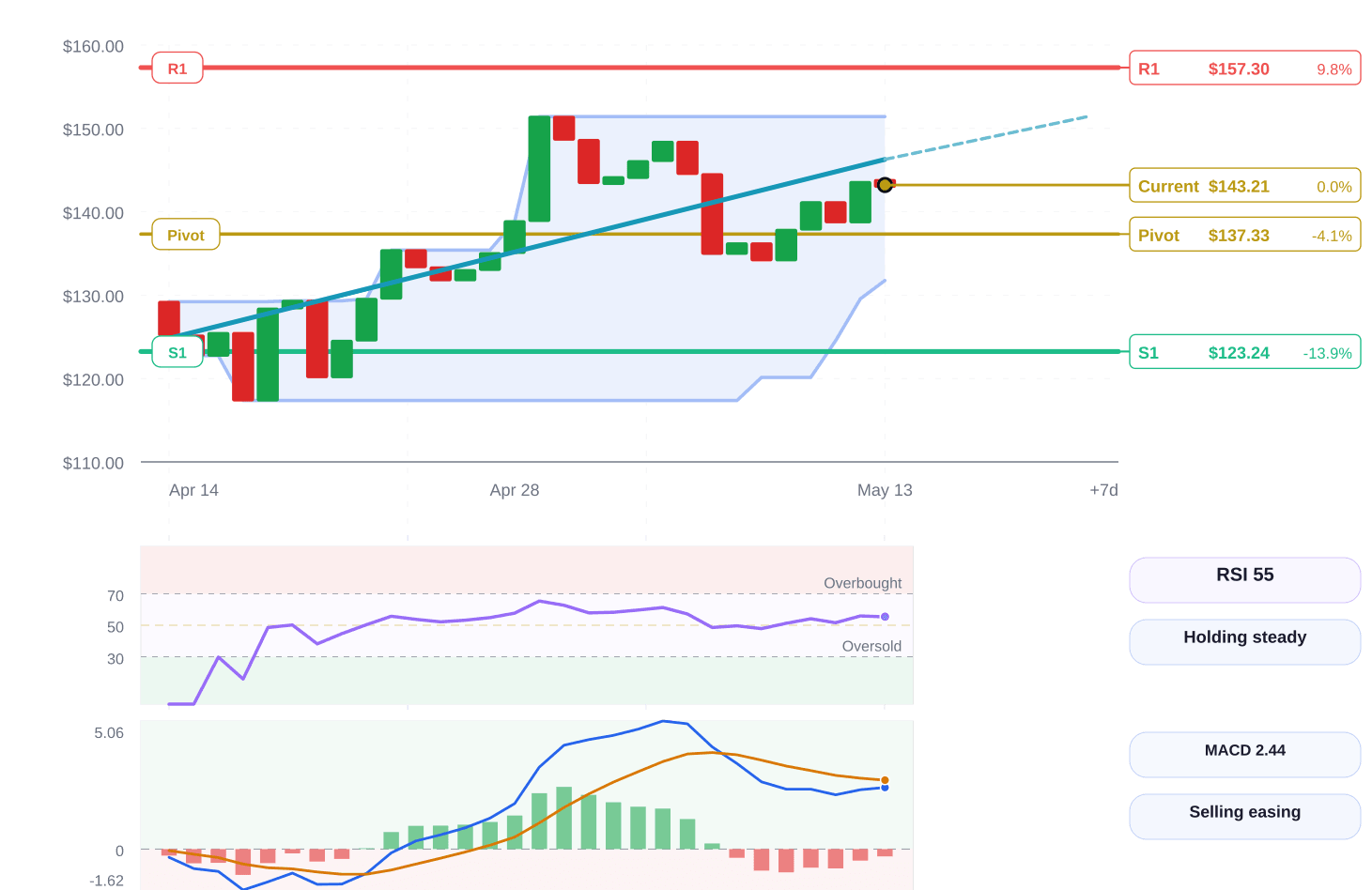
Oil led the majors at 6.1% this week.
Oil is trading near $143.21, and the broader structure is still leaning higher. The price moved 6.1% over the last 7 days, keeping the narrative in an active rotation rather than a flat consolidation. Momentum is mixed, so follow-through matters more than assuming a straight-line continuation from here.
5 Changes That Matter

1 Charles Schwab has begun rolling out spot crypto trading for retail customers, marking the firm's first direct crypto offering.
Schwab manages roughly $10 trillion in client assets. That's not a crypto-native platform adding a feature. That's the largest retail brokerage in America opening the door. For years, Schwab clients who wanted crypto had to leave the platform entirely, or settle for ETF wrappers. Now they don't. The implications aren't just about Schwab's revenue line. It's about normalization. When your parents' brokerage sells Bitcoin the same way it sells Apple stock, the "crypto is for tech bros" narrative quietly dies. The timing is interesting too: Fear & Greed sits at 42, sentiment is soft, and Schwab chose now to launch. That's either brave or very well-timed for onboarding retail at a discount.
If Schwab reports meaningful crypto trading volume in its next quarterly update, it confirms retail demand was supply-constrained, not demand-constrained. If volumes disappoint, it suggests the real barrier wasn't access. Watch for competitor announcements from Fidelity or Vanguard within 30 days. A second major brokerage following suit would confirm a structural shift.

2 JPMorgan is launching a second tokenized money market fund on Ethereum, while tokenized Treasuries industry-wide have crossed $15 billion in total value.
JPMorgan doing this once was a proof of concept. Doing it twice on the same chain is a product strategy. The bank isn't experimenting anymore. It's building a product line. And the broader context matters: tokenized Treasuries at $15 billion means this isn't JPMorgan alone. BlackRock, Franklin Templeton, and others are all stacking up on-chain fixed income. The thesis here is simple: if you can earn yield on-chain with the same counterparty risk as a money market fund, why keep capital off-chain? That question is increasingly hard to answer. The interesting wrinkle is Anthropic publicly slamming tokenized equity instruments this week. Debt instruments are getting traction. Equity tokenization is where the real fight starts.
If JPMorgan's second fund attracts institutional inflows above its first fund's launch size within 60 days, the tokenization flywheel is real. Watch for SWIFT or Euroclear making a comparable on-chain announcement within 30 days. A second Tier-1 financial institution naming Ethereum as its settlement layer would confirm this is infrastructure, not marketing.

3 Coinbase launched x 402, a batch settlement protocol designed for AI agent payments, letting autonomous agents pay for services on-chain without human approval loops.
This is the most structurally interesting story of the week and almost nobody's talking about it. The problem with AI agents making payments today: they have to route through human-controlled wallets, API keys, or credit cards. Every payment requires a human somewhere in the loop. x 402 cuts that out. Agents can authorize and settle payments directly on-chain, in batches, with programmable rules. The use case sounds niche until you realize that every AI workflow that touches an external service eventually needs to pay for it. Data APIs, compute, storage, licensing. If x 402 becomes the standard settlement layer for AI agent payments, Coinbase just inserted itself into the backbone of the agentic economy. That's not a feature. That's a platform play.
If major AI frameworks like LangChain or Auto GPT integrate x 402 within 90 days, Coinbase has a real developer moat. If adoption stays within Coinbase's own ecosystem after 60 days, it's a walled garden, not a standard. Watch developer GitHub activity on the x 402 repo as the leading indicator.

4 Jane Street slashed its Bitcoin ETF holdings and added Ether funds in Q1 2026, according to new filings.
Jane Street isn't a retail investor making vibes-based decisions. They're one of the most sophisticated market makers on the planet. When they rotate out of BTC ETFs and into ETH funds, it's worth asking why. One read: they see better relative value in ETH after its underperformance. Another read: they're adjusting their hedging book, and the ETH position is a market-making offset, not a directional bet. The honest answer is we don't know which. But the directional signal is there. ETH has been the unloved major for months. If smart money is quietly rotating in, the narrative might be about to change. The timing also matters: this happened in Q1, before the current soft sentiment patch. They bought the dip before the dip got softer.
If ETH/BTC ratio breaks above its 30-day resistance within the next 7 days, Jane Street's Q1 move looks prescient. If ETH continues to underperform BTC through the end of May, the rotation was either early or purely mechanical. Watch the ratio daily.
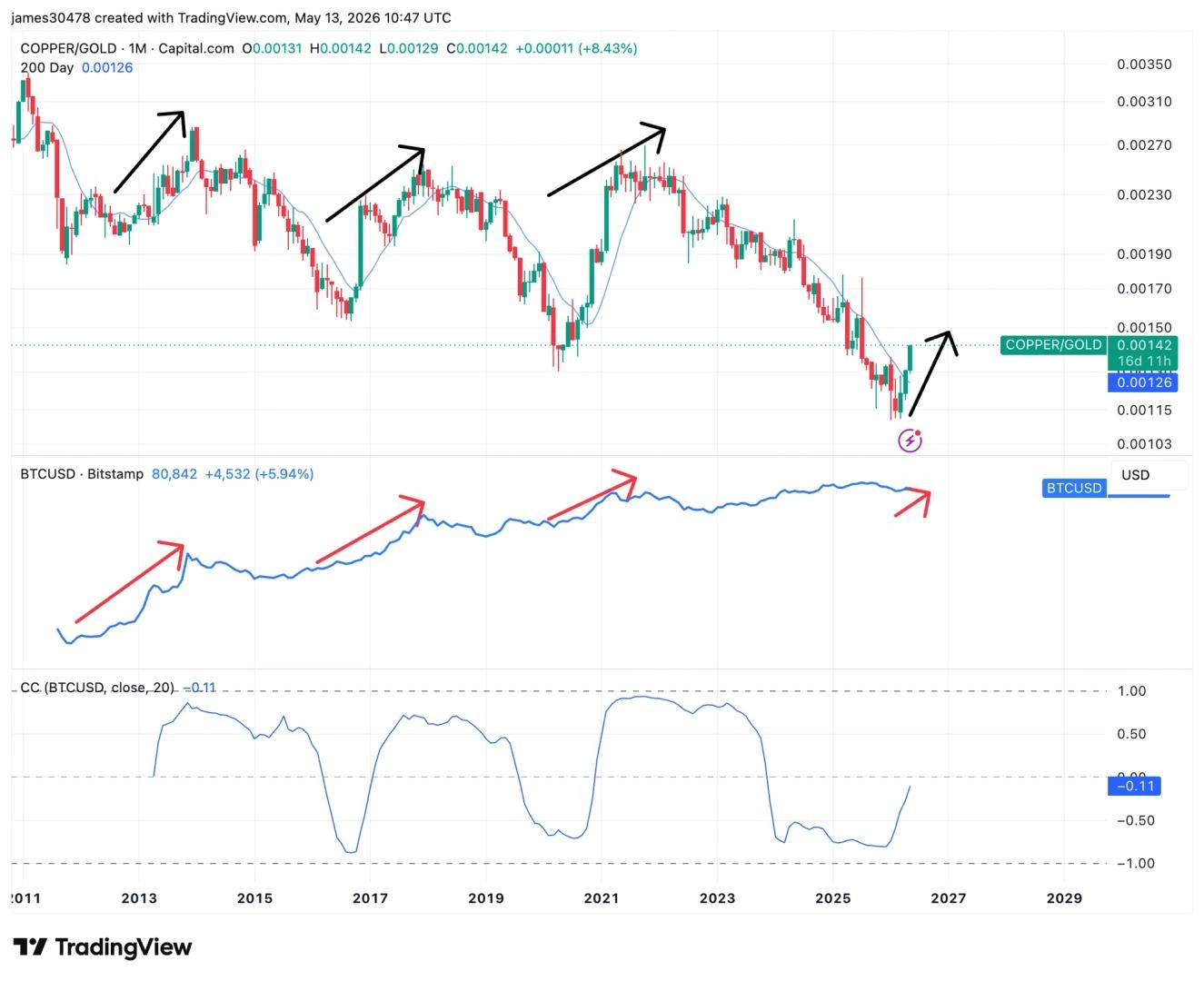
5 The copper-to-gold ratio just broke out in a pattern last seen in 2020, a macro signal that historically preceded Bitcoin breakouts.
The copper-to-gold ratio measures risk appetite at the macro level. Copper is an industrial metal that rises when economies are growing. Gold is a safe haven that rises when people are scared. When copper outperforms gold, it means the market is betting on growth, not fear. In 2020, this breakout preceded Bitcoin's run from under $10 thousand to over $60 thousand. That's not a prediction. Macro signals aren't destiny. But it's a useful second-order frame: if the broader market is pricing in economic expansion, risk assets tend to benefit, and BTC has increasingly traded as a risk asset. The catch: BTC is currently sitting below $81 thousand with sentiment at Fear. The macro signal is bullish. The on-chain sentiment is not. One of them will be right.
If BTC reclaims and holds above its 200-day moving average within 7 days while the copper-to-gold ratio stays elevated, the macro signal is confirming. If BTC breaks below $79 thousand while the ratio holds, it means crypto-specific headwinds are overriding the macro tailwind. That divergence would be the more important signal.
Sponsored

Polymarket — Bet on real-world events with real money on the world's prediction market.
Predict & Earn →Risk Map
01 Sentiment slipping while price holdsFear & Greed dropped 7 points in one day to 42, back into Fear territory, while BTC is barely down on the day. When sentiment deteriorates faster than price, it usually means the next leg lower finds less support. Retail is quietly losing conviction. If price catches down to sentiment rather than sentiment catching up to price, the 200-day moving average test gets real. |
02 L2 liquidity fragmentation acceleratingMega ETH TVL is down 37% this week. Unichain, Aevo, and Derive are each down over 11%. Total L2 TVL is off about half a percent for the week. Capital isn't leaving crypto. It's becoming harder to track where it's going. When liquidity fragments across dozens of L2 s without clear winners, slippage rises and DeFi composability breaks down. Arbitrum and Base are holding, but the long tail is bleeding. |
03 Tokenized equity confusion creates regulatory flashpointAnthropic publicly disavowed tokenized pre-IPO shares circulating under its name. This is the second-order risk nobody is pricing: if retail investors get burned by unauthorized tokenized equity products, the regulatory response won't be surgical. It will be broad. And that response lands on the legitimate tokenization projects, like JPMorgan's money market funds, at exactly the moment they're gaining traction. |
Catalysts (Next 7 Days)
📅 Charles Schwab spot crypto rollout: early adoption data Rolling - next 7 days
Schwab's launch is live. The first week of trading data will reveal whether demand was supply-constrained or simply absent. High early volumes would be a structural bullish signal for retail onboarding.
📅 Bitcoin 200-day moving average test Next 7 days
BTC is trading below $81 thousand with the 200-day MA acting as overhead resistance. A clean reclaim would flip the technical structure bullish. A rejection here keeps the range-bound grind intact and puts $79 thousand back in play.
📅 CLARITY Act legislative progress Week of May 13
The Senate markup process for the CLARITY Act crypto market structure bill is ongoing. Bitwise's CIO flagged it as the next major unlock for institutional tokenization products. Any committee vote or amendment news this week moves markets.

Sources
- Charles Schwab has begun rolling out spot crypto... coindesk.com
- JPMorgan is launching a second tokenized money market... bankless.com
- JPMorgan is launching a second tokenized money market... decrypt.co
- JPMorgan is launching a second tokenized money market... coindesk.com
- Coinbase launched x 402, a batch settlement protocol designed... cointelegraph.com
- Jane Street slashed its Bitcoin ETF holdings and... cointelegraph.com
- The copper-to-gold ratio just broke out in a... coindesk.com
- Bitcoin 200-day moving average test coindesk.com
- CLARITY Act legislative progress theblock.co
- coingecko.com coingecko.com
- defillama.com defillama.com
- stablecoins.llama.fi stablecoins.llama.fi
- alternative.me alternative.me
Disclosures
Not investment advice. For education only. Crypto is high risk. We may earn affiliate revenue from some links.
